
In food processing, blanching is not merely a method of heating vegetables; it is a critical pre-treatment step that ensures product quality. Since different vegetables vary in tissue structure, moisture content, and thickness, their requirements for blanching temperature and time also differ. If parameters are set improperly, problems such as discoloration, overly soft texture, and uneven heating can easily occur, affecting subsequent freezing, dehydration, or packaging processes.
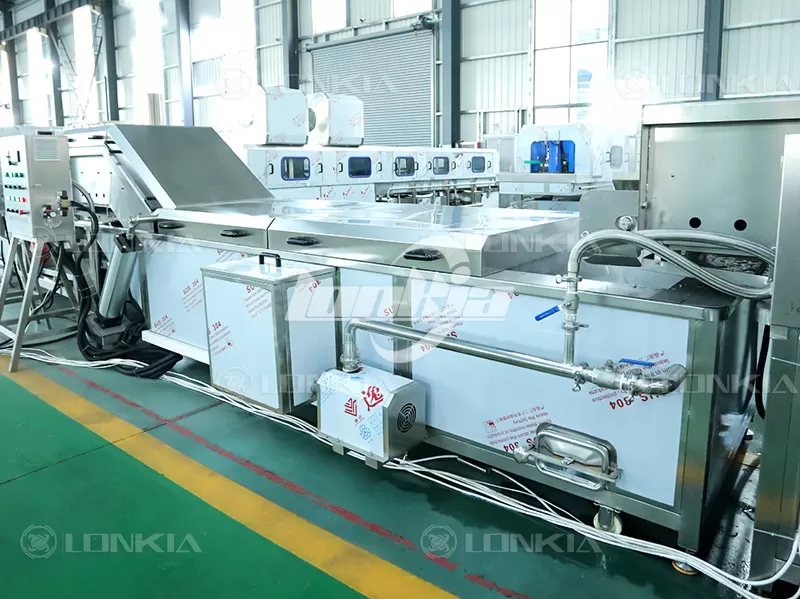
A vegetable blanching machine with stable performance can ensure consistent blanching results for different products through precise temperature control and stable conveyor operation, thereby improving the processing stability of the entire production line.
How Does a Vegetable Blanching Machine Achieve Precise Temperature Control?
High-quality vegetable blanching machines typically employ an automatic temperature-control system that continuously adjusts the water or steam temperature according to product requirements, minimizing fluctuations caused by manual intervention. An internal circulation heating system maintains uniform temperatures throughout the tank, preventing localized overheating or insufficient heating.
At the same time, the conveyor belt speed can be adjusted according to processing requirements, thereby controlling the dwell time of the produce in the blanching zone. When temperature and conveyor speed are properly coordinated, consistent blanching quality is ensured for every batch, even during continuous production.
How Should Equipment Parameters Be Adjusted for Different Vegetables?
Although the specific parameters for different products must be determined through actual testing, the equipment should offer flexible adjustment capabilities to accommodate various processing needs.
For example:
- Leafy vegetables typically require a shorter blanching time, so the conveyor speed should be appropriately increased.
- Root and tuber vegetables require a relatively longer heating time; therefore, the conveyor speed and temperature should be adjusted to ensure thorough heating throughout the interior.
- Products such as cauliflower and legumes require a balance between color retention and texture integrity, so they rely more on stable, constant-temperature control.
Compared to equipment with fixed parameters, an adjustable vegetable blancher can meet the production needs of multiple varieties, reducing equipment changeover and setup time while improving production efficiency.
What Should You Look for When Choosing a Vegetable Blancher?
For procurement personnel, focusing solely on the blanching temperature range is insufficient; greater attention should be paid to whether the equipment itself is capable of stable operation, including:
- An automatic temperature control system that maintains the set temperature in real time;
- Adjustable conveyor speed to accommodate different product processing rhythms;
- A recirculating heating structure to improve temperature uniformity within the tank;
- Food-grade 304 stainless steel construction for easy daily cleaning and maintenance;
- Modular design for easy future maintenance and integration into production lines.
These features directly impact blanching consistency and serve as key indicators of equipment performance.
How Can You Achieve Stable and Consistent Blanching Results?
Stable processing quality depends not only on temperature and time but also on the equipment's overall performance. A well-designed vegetable blanching machine can consistently maintain a constant temperature, ensure uniform conveying, and operate stably, thereby reducing product quality fluctuations and minimizing the need for manual adjustments.
Lonkia specializes in the manufacture of food processing equipment and offers a variety of vegetable blanching machine configurations tailored to different vegetable processing needs. We help customers achieve stable, efficient, and continuous production while meeting the requirements of subsequent processes such as cooling, quick-freezing, dehydration, and packaging.
Conclusion
For food processing companies, there is no one-size-fits-all standard for blanching parameters; instead, adjustments must be made based on the specific characteristics of different vegetables. Rather than repeatedly modifying processes, a vegetable blanching machine equipped with precise temperature control, adjustable conveying, and a stable heating system is better positioned to help companies achieve consistent product quality and stable production efficiency. During the equipment selection phase, prioritizing the machine's control performance and operational stability will deliver greater processing value for subsequent production.