
In the processing of pickled cucumbers, ready-to-eat cucumber products, or central kitchen operations, washing quality directly determines product safety, taste, and appearance. Traditional manual rinsing struggles to remove soil, salt residue, and surface contaminants, while also being inefficient and inconsistent. Consequently, professional cucumber cleaner machines have become essential equipment in cucumber processing lines. This article analyzes how to achieve hygienic, uniform, and efficient cleaning results, focusing on equipment structure and practical applications.
Why Do Pickling Cucumbers Require Mechanical Cleaning?
Pickling cucumbers typically originate from open-field cultivation, with surfaces coated in soil, microorganisms, pesticide residues, and salt. Inadequate cleaning may lead to:
- Pickling brine contamination or cloudiness
- Unstable finished product texture
- Shortened shelf life
- Increased food safety risks
Industrial washing equipment ensures consistent cleanliness across each batch through continuous and standardized operations, eliminating human variability.
Bubble Tumbling Wash: Gentle Yet Thorough
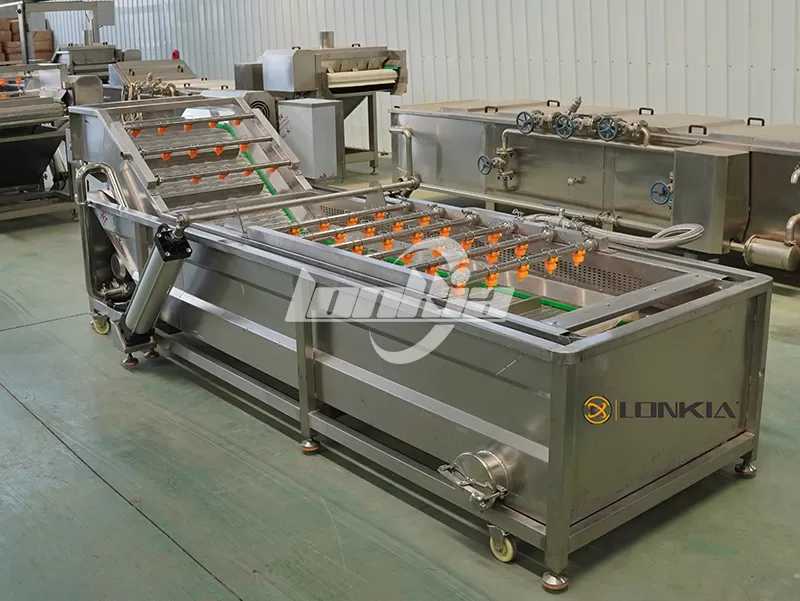
Modern cucumber washing machines predominantly use bubble water wash structures. Dense bubbles generated at the tank bottom cause cucumbers to tumble and separate, achieving all-around cleaning.
The impact force from bursting bubbles effectively strips away dirt and impurities without damaging the delicate skin.
This method is particularly suitable for pickling cucumbers, which require maintaining their intact shape.
Dual-stage Spray Rinsing Ensures Residue-free Results
Premium vegetable washing equipment typically incorporates a high-pressure spray system:
- Stage 1: Bubble agitation removes adhering particles
- Stage 2: Fresh water spray thoroughly flushes contaminants
- Multi-row nozzles cover the entire surface
This dual-stage cleaning significantly enhances cleanliness, commonly used in export-grade food processing. The combined action of bubbles and water flow achieves multi-angle cleaning.
Continuous Conveying Ensures Uniform Cleaning
Cucumber cleaner machines typically feature mesh belt or chain conveyor systems for stable ingredient progression:
- Uniform force applied to each cucumber
- No accumulation or omission
- Controllable cleaning duration
- Seamless integration with downstream equipment
Bubble-driven water circulation also flips ingredients in the water, enabling uniform cleaning without surface damage.
Food-grade Construction Ensures Hygiene and Safety
Food processing demands stringent material standards. Mainstream models utilize food-grade stainless steel construction, offering:
- Corrosion and cleaning resistance
- Non-absorption of odors
- Easy daily maintenance
- Long-term stable operation
High-quality equipment (such as Lonkia's bubble washing machines) emphasizes minimal hygiene dead zones and easy cleaning in design, suitable for continuous long-term production.
Key Advantages for Pickling Production Lines
For the pickling industry, premium cucumber washing equipment should deliver:
- High-efficiency removal of sand and salt
- No damage to skin integrity
- Continuous, stable operation
- Seamless integration with slicing and pickling equipment
Bubble washing achieves high cleanliness while preserving raw material integrity, making it the most widely adopted solution today.
Conclusion
For pickling or deep-processing enterprises, selecting the appropriate ccucumber cleaner machine is not merely an efficiency issue—it forms the foundation of quality and safety. Through a combined design of bubble agitation, spray rinsing, and continuous conveying, it achieves hygienic, uniform, and stable cleaning results, providing reliable raw materials for subsequent processing.
If your production line requires a stable, efficient, and food-grade cleaning solution, our customized equipment will significantly elevate your overall processing standards.