
When establishing an efficient sardine canning plant, the spatial planning of the facility and the layout of key equipment determine production efficiency, the smoothness of daily maintenance, and product consistency. This guide will help clients planning or upgrading sardine canning production lines address practical issues from the perspectives of machine configuration and on-site processes.
Understanding the Core Equipment Flow of a Sardine Canning Plant
Before designing the spatial layout, it is essential to understand the primary stages and required equipment of a sardine canning plant:
- Fish Pre-processing Equipment: Thawing machine, conveyor belt → Washing machine → Scaling machine → Deboning machine
- Filling and Capping System: Automatic filling machine → Capping machine
- Sterilization & Canning Process: Autoclave → Cooling zone
- Final Packaging & Palletizing: Labeling machine → Case conveyor → Palletizer
These devices operate sequentially, forming a seamless assembly line from raw fish intake to finished product packaging and warehouse dispatch.
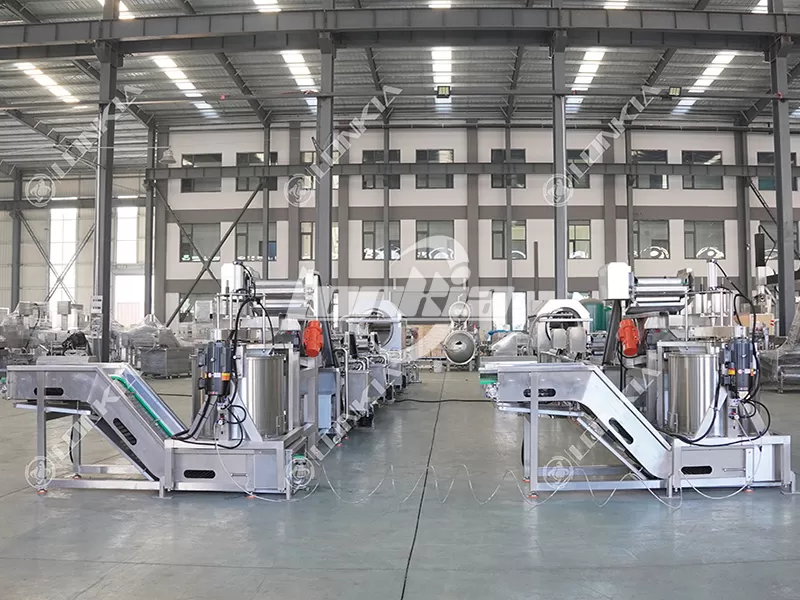
Allow Sufficient Space for Maintenance and Operation Around Critical Equipment
All equipment in a sardine canning plant requires regular inspection and maintenance, including automatic fillers, twin-head cappers, and autoclaves. Layout planning must reserve adequate access pathways for operator movement and the transport of tools and spare parts. Typical recommendations include:
- Maintain at least 0.8 meters of clearance around equipment front and rear for operational access;
- Design spacious platforms around autoclaves for easy monitoring of pressure and temperature control panels.
- Install drainage systems in the cleaning area floors to prevent water accumulation that could disrupt subsequent processes.
Reasonable spacing not only enhances production efficiency but also reduces unexpected downtime caused by crowding.
Optimizing Workflow to Minimize Cross-Contamination
Sardine canning plants involve multiple process stages. To prevent workers from crisscrossing and minimize material cross-contamination, a unidirectional production flow is recommended. For example:
- Raw fish enters from left to right.
- Progresses through gutting, scaling, pre-cooking, and filling;
- Post-filling, proceed to capping, checkweighing, and sterilization;
- Finally, exit through the finished product discharge point.
This design is not only intuitive but also minimizes the risk of disorganized material stacking, clarifying the function of each piece of equipment.
Equipment Installation Requires Power and Ventilation Considerations
In sardine canning plants, automated equipment like fillers, conveyors, and cappers concentrates power demands in specific workshop areas. When planning electrical wiring, consider:
- Positioning the main power control cabinet near equipment clusters.
- Installing dedicated switches for emergency shutdowns;
- Extending ventilation systems to cover high-temperature equipment like pre-cooking kettles and sterilization autoclaves.
These measures enhance operational stability and on-site safety.
Layout Planning Must Accommodate Future Expansion
Facility layout should not only address current needs but also allow room for growth. For example, reserving modular expansion zones in the gutting and pre-cooking areas of a sardine canning plant prepares for future additions like deboning or cooling lines. Lonkia's equipment series supports modular assembly, allowing configurations to adapt to business growth.
Summary
The layout and equipment installation in a sardine canning plant are not simply stacking but a rational design integrating production processes and machine characteristics. Clear workflow paths, ample operational and maintenance space, integrated electrical and ventilation planning, and provisions for future upgrades significantly enhance production efficiency and product consistency. A scientifically laid-out sardine canning plant not only reduces manual intervention but also delivers more stable long-term production capacity.
For customized equipment layout solutions tailored to your production capacity and facility space, please get in touch with us. We provide layout recommendations, equipment selection guidance, and installation support based on your specific requirements.