
When selecting a canned tuna production line, many customers first focus on production capacity—for example, how many cans can be produced per hour. However, in actual projects, production capacity is not a fixed number; rather, it is determined by the combined operational status of the entire production line.
Rather than looking solely at equipment specifications, it is better to start with the production process itself to understand how production capacity is determined.
Production capacity depends on the operational rhythm of the entire line
Canned tuna production is a continuous process; from raw material processing to final sterilization, each stage has a corresponding processing time.
In actual production, the line's overall capacity is often determined by the slowest process step. If a particular stage lacks sufficient processing capacity, it will affect the overall output. For example:
- Unstable processing in the early stages can cause equipment in later stages to operate intermittently
- If the filling and sealing cycles are out of sync, bottlenecks are likely to occur
- A long sterilization cycle limits the overall throughput
Therefore, production capacity is more accurately described as a "balanced outcome" rather than the speed of a single piece of equipment.
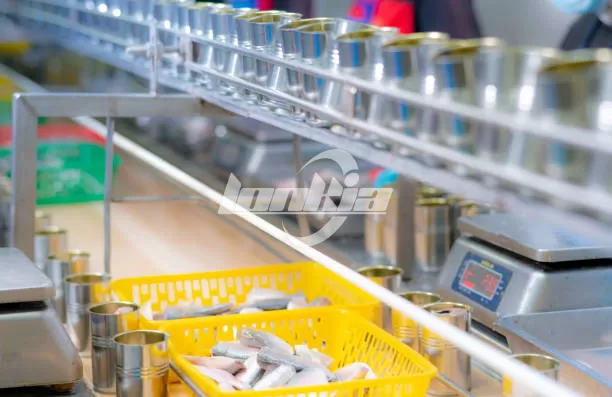
Key Equipment Stages Affecting Production Capacity
Within the entire canned tuna production line, several stages have a direct impact on production capacity.
- Filling Stage: Filling speed typically determines the baseline cycle time for the entire line. If the filling process is stable and precision is controllable, the production line is more likely to maintain continuous operation.
- Capping Stage: Stability is key to capping. If sealing quality is inconsistent, it increases rework or downtime for adjustments, thereby affecting overall efficiency.
- Sterilization Stage: Sterilization is a timed process that generally requires a fixed duration to complete. If the preceding and following cycle times are poorly designed, it can easily lead to backlogs or waiting times, thereby affecting the realization of production capacity.
- Conveying and Interconnections: The smoothness of material transfer between equipment also affects actual operational efficiency. Poor coordination can easily lead to brief pauses or material buildup.
Why Is Actual Capacity Lower Than Expected?
In actual operation, canned fish production line capacity is often lower than the equipment's rated capacity, which is a normal occurrence. Common reasons include:
- Incompatibility between different pieces of equipment
- Brief shutdowns during the production process
- Adjustment time required for product specification changes
- Operator proficiency affecting operational continuity
Therefore, when evaluating production capacity, it is necessary to consider actual operating conditions rather than relying solely on a single parameter.
How to Evaluate Production Capacity More Reasonably?
For purchasers, the following aspects should be considered:
- Whether the canned tuna production line can operate stably over extended periods
- Whether the processing capacities of each stage are well-matched
- Whether it supports switching between different product specifications
- Whether daily operations require frequent manual intervention
Compared to theoretical speeds, these factors more accurately reflect real-world production conditions.
Recommendations for Production Line Configuration
In actual projects, a more reasonable approach is to determine equipment configuration based on target output rather than simply selecting high-speed equipment.
A stable production line typically exhibits the following characteristics:
- Coordinated cycle times across all equipment
- Smooth material flow
- Minimal fluctuations during operation
- Relatively simple maintenance and operation
In terms of overall canned tuna production line design, solutions such as Lonkia's place greater emphasis on equipment compatibility and operational stability to ensure a relatively smooth production process.
Conclusion
For a canned tuna production line, "how many cans per hour" is merely a reference metric. What matters more is whether this production capacity can be consistently achieved in actual production.
During the equipment selection process, evaluating the operational rhythm and equipment compatibility from a whole-line perspective typically contributes more to stable production in the long run. If you are planning a project, feel free to contact us at any time. Lonkia can provide more reasonable recommendations for the entire canned food production line configuration based on your target output.